
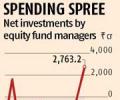
Though the sum was nowhere close to the big-ticket monthly purchases seen during the 2004-2008 bull run, it is significant, as it confirms the reversal of a selling spree that began in September 2013.
We have highlighted the performances of some of the leading diversified equity funds that have completed a decade long existence.

The spike in volatility, amid election uncertainty, has done little to dent the confidence of retail investors, shows demat account addition and equity mutual fund (MF) investment data. In May, investors opened a net 3.6 million demat accounts, taking the total to 158 million. MF data released on Monday pegged the net inflows into equity schemes and SIP investments at new record highs of Rs 34,697 crore and Rs 20,904 crore, respectively.

The country's mutual fund industry posted five per cent growth in average assets under management (AUM) to touch all-time high of Rs 8.68 lakh crore in May on the back of strong inflows into money market and income funds.
The Reserve Bank of India on Thursday raised the overall limit for overseas investment by domestic mutual funds from $5 billion to $7 billion. Industry estimates peg the amount invested overseas at $1 bn to $2 billion. Only last September, RBI had raised the overseas investment limit for mutual funds from $4 bn to $5 bn. RBI said the overall ceiling for investment in overseas exchange-traded funds will continue to be at $1 bn. There are about 17 schemes that invest overseas.
Total MF investments in debt papers like certificate of deposits, commercial papers and collaterised borrowing and lending obligations stood at around Rs 184,000 crore at the end of February. Industry experts said that by March-end, this corpus had depleted by over 50 per cent. "The industry would have lost around Rs 1 lakh crore as banks and institutions redeemed their investments during the last week of March," said Jaideep Bhattacharya of UTI Asset Management Company.

The number of active SIP accounts is nearing the 100 million milestone.

Infrastructure funds, which bet on stocks closely linked with infrastructure development in the country, have emerged as one of the best-performing categories over the past year. They have generated an average return of 90.63 per cent - the third-best, after technology funds and small-cap funds. Of the 21 schemes in the category, seven have given a return of more than 100 per cent in a year.

Retail participation in mutual funds from beyond the top 15 cities in the country has increased remarkably in the past 18 months.

The best way to achieve financial security isn't by cutting out every vada pav or limiting yourself to home-cooked meals; it's by making yourself indispensable at work, says Vatsal Ramaiya.

MFs have benefited from a shift to financial assets from physical assets like real estate and gold.
The mutual fund industry has witnessed a value erosion of Rs 75,966 crore (Rs 759.66 billion) in equity-related schemes in the first seven months of the current financial year. This is primarily because of the slide in the equity market on account of the global financial turmoil.

The financial numbers for 2023-24 (FY24) of the four pure-play listed asset management companies (AMCs) have enthused the Street. All firms listed robust growth in net profit and revenue both during the January-March quarter (Q4) of FY24, as well as in full FY24. The strong performance comes amid a positive growth environment for the sector, led by tailwinds such as sharp growth in assets under management (AUM) and robust performance in equity offerings.
The government is considering the setting up of a mutual guarantee fund by the IT/software industry associations as part of efforts to ease availability of finance for small IT entrepreneurs, a top official said on Friday.\n\n\n\n
The Indian mutual fund industry's assets under management race from Rs 3 trillion to Rs 4 trillion has come in just nine months.

Multi-asset allocation funds emerged as the most popular option for MFs as they provided the needed flexibility.

Equity debt, gold - these all are terms you may have heard of when reading on funds but not quite sure where to start with or which one most suits your needs.

'Due to tariff uncertainty, automotive customers reduced their steel uplift by almost 15 per cent.'

Dealers said the discounts this March are higher than the same month in the previous year.

Assets under management of India-dedicated funds have slid 20 per cent in the year to November to $35.2 billion.
It hurts to see retail investors become unwitting preys to games being played by AMCs (asset management companies) and mutual fund distributors.
MFs greet FMs decision on overseas investment

'We plan to launch new initiatives, including cash flow-based lending, to ensure borrowers are not burdened and can access funds more quickly.'

Although net inflows into equity mutual funds deteriorated month-on-month (M-o-M) in March 2024 to Rs 22,576 crore (excluding Hybrid), down 15 per cent M-o-M (up 12 per cent Y-o-Y), asset management companies (AMCs) had a great year with robust growth in assets under management (AUMs). AMCs are likely to report strong PAT growth (30-40 per cent Y-o-Y) in Q4FY24 on the back of AUM growth. In Q4FY24, domestic mutual fund (MF) industry's quarterly average AUM grew by 34 per cent Y-o-Y and 10 per cent quarter-on-quarter (Q-o-Q) to Rs 54 trillion ($652 billion).

'More investors now view the stock market as a valuable opportunity, though many still seek quick gains, leading to a rise in futures and options trading.'

rediffGURU and financial planning expert Colonel Sanjeev Govila (retd) answers your personal finance-related questions.

It boosts confidence to investors sitting on the fence.
In a bid to tap the growing potential of mutual fund business in the country, ICICI Bank has decided to raise its stake in Prudential ICICI Asset Management Company to 51 per cent, by buying out six per cent stake from Prudential Plc.
Debt-oriented mutual funds have continued to give positive returns in February, while almost all the equity schemes ended in the negative, a latest study said. According to Crisil FundServices, provider of fund evaluation and risk solutions to the Indian MF industry, debt funds showed positive momentum, while equity funds continued to slide in February.

The Covid winter seems to be finally ending for debt-oriented mutual fund (MF) schemes as interest rates peak, especially for those that invest in shorter-maturity papers. In the past two months, shorter-horizon debt schemes - ultra-short, low-duration, and money-market - have together raked in net inflows of Rs 48,000 crore, the highest for two months since April-May 2021. These schemes invest in shorter-maturity papers ranging from three months to a year.

Backed by their strong physical presence across the country, UTI Mutual Fund and SBI Mutual Fund (MF) have managed to mobilise a higher proportion of their total assets under management (AUM) from towns and villages than their peers. Data compiled by Nuvama Institutional Equities shows that UTI MF and SBI MF are the only two major fund houses with over a fifth of their AUM coming from areas beyond the top 30 cities (referred to as B-30). UTI MF tops the chart with 23.8 per cent of its assets belonging to B-30 centres, followed by SBI MF with 21.2 per cent B-30 assets. The industry average stands at 17 per cent.

T'I am not going to buy small- or mid-cap stocks at very high valuations if it doesn't make sense for the investors.'

Mutual funds subscriptions and redemptions will not be permitted on February 1 because all the fund houses in their scheme information documents have declared Saturday and Sunday as "non-business day".

One-sponsor-one-fund rule may set off merger as Amundi seen sponsoring two funds following buyout.

Don't exit from growth-style funds as they may benefit next from a shift in investor preference.

'MFs acted as reckless lenders and not as prudent investors.' 'Clearly, how debt funds are being run is a systemic issue,' warns Debashis Basu.

Equity mutual fund (MF) schemes have raked in Rs 46,200 crore in net lump-sum inflows in the past six months (ended February 2024), almost thrice the inflow in the previous six-month period.
